A Closer Look at a Chair Before You Sit
Use this chair observation exercise to map a seat’s parts, visible structure and relation to its room, then write a clear account without guessing.
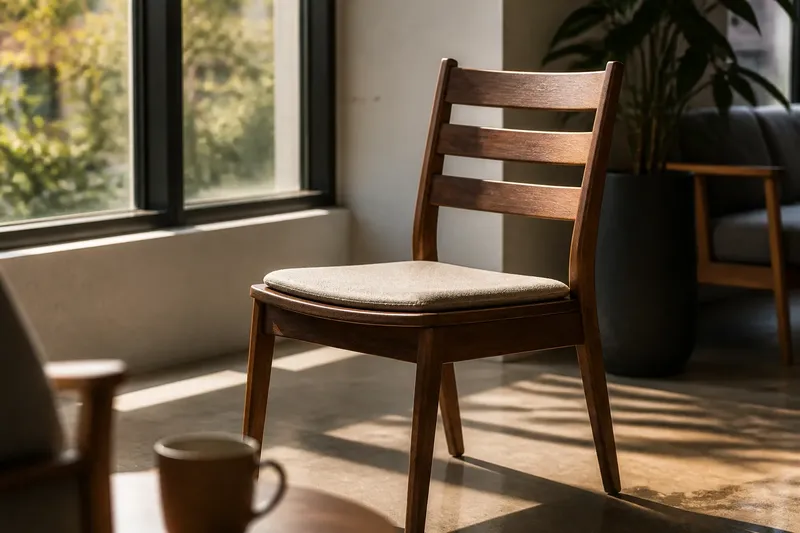
A chair observation exercise can begin while you wait for an appointment: the empty chair beside the window has a pale seat, dark legs and a back that leans slightly away. Rather than guessing whether it is comfortable, use those visible details to understand how its form is organised.
Keep the focus on the chair’s construction and visual structure. You can do this from where you are sitting, without touching or moving it. Trace the outline, note how parts meet, and distinguish what is visible from what remains hidden.
Map the chair’s outline before naming its parts
Begin with the chair’s silhouette. Notice whether it is built from separate-looking pieces, such as a seat, back and legs, or whether a continuous shell forms several of those parts. Look at the spaces around and beneath it: open gaps make the frame legible, while broad panels conceal more of the structure.
Then follow the main lines. A straight seat edge may meet a curved back; legs may continue into the frame or appear to attach beneath the seat. Describe those relationships before assigning a style or purpose. “The back curves into the seat” is more precise than “the chair is ergonomic” when you cannot inspect how it feels.
Notice the balance of visual weight. A thick seat above slender legs creates a different impression from a narrow frame with broad side panels. This is a description of appearance, not a measure of strength or stability.
Read how the seat and back are assembled
Look at the seat’s surface and edge. Is it a single visible panel, a cushion set on a frame, or a formed surface that bends towards the back? Check whether its boundary is exposed, covered by upholstery or tucked inside a surrounding rail. These details show how the seat is presented as an object, even when the fixing method cannot be seen.
Follow the backrest from its upper edge down to the seat. A slatted back reveals spaces between its components; a solid panel presents a continuous surface; upholstery can cover the structure beneath. If the back and seat seem to flow into one piece, record that visible continuity without assuming they were made in a single operation.
Say you are looking at an invented chair with a separate fabric pad on a timber seat and a back made of three horizontal slats. First, note the pad’s seam and the visible timber edge. Next, trace the slats to the side rails and mark where their ends disappear. Your resulting description might read: “A fabric pad sits on a visible timber seat; three slats span the back between side rails.” The connections at the slat ends remain unknown, so the account does not claim whether they are screwed, glued or fitted into slots.
Trace the frame from the seat to the floor
Follow each visible leg downwards. Note whether the legs are straight, angled or joined to a central base, and whether they continue in the same line or change direction. If you can see crossbars between them, record their position; if not, say that no crossbars are visible from your viewpoint.
At the floor, look for feet, caps or glides. These small components can interrupt the line of a leg and make the contact point visible. Their appearance does not establish what they are made of or how they affect the floor, so avoid claims about protection or durability unless you have reliable information beyond a glance.
Check how the frame meets the seat. A rail may run beneath the seat edge, a leg may attach directly to it, or a covering may hide the junction. If the joint is obscured, that is the result of the observation: do not fill the gap with a likely-sounding construction story.
Use visible details to describe structure accurately
Choose concrete nouns and verbs: “four legs angle out”, “a rail runs beneath the seat”, or “the back has open slats”. Add a cautious interpretation only when it follows plainly from the form. For instance, an open frame leaves more of the space behind it visible; it does not, by itself, prove that the chair is lighter to move or easier to clean.
Use this checklist to decide what to record next:
- Seat edge: If the edge is exposed, describe its profile and what sits beneath it; if upholstery hides it, record the covering and leave the underlying construction unspecified.
- Seat and back: If they meet as a visible continuous form, note that outline; if a seam or gap separates them, describe the boundary instead of assuming how the parts are joined.
- Back surface: If you can see through openings, count or describe their arrangement; if the surface is solid or covered, record that and do not infer hidden supports.
- Leg direction: If the legs angle away from the seat, describe the direction and spacing; if their ends are hidden, leave the floor-contact arrangement unresolved.
- Crossbars: If a bar is visible between legs, note its location; if none is visible, state that rather than concluding that the frame has no reinforcing parts.
- Fasteners: If a screw or bolt is visible, identify its position and appearance; if no fixing can be seen, record that the connection is concealed rather than judging the chair’s quality.
- Surface finish: If grain, weave, sheen or a coating is visible, describe that feature; if the material is uncertain, name the surface appearance instead of guessing its composition.
These decisions keep a description useful without turning it into a verdict. They also help you separate a chair’s visible construction from questions—such as comfort, strength or intended use—that a visual inspection alone cannot settle.
What can you tell from a chair at a glance?
Can I identify the chair’s material by looking?
You can describe clear surface features such as grain, weave, sheen or a visible edge. If a coating or composite makes the material uncertain, describe the appearance rather than naming a material as fact.
Do exposed joints tell me how the chair was made?
They show where parts meet, and visible screws, seams or gaps may reveal some features of the assembly. A glance cannot establish the complete method, especially where the connection continues inside the frame.
Can the shape tell me whether the chair is comfortable?
It can show features such as a curved back, a padded surface or an upright outline, but those do not settle how the chair feels to a particular person. Treat comfort as a question that requires sitting in the chair, not as a conclusion from appearance.
How should I describe a part I cannot see?
State what blocks the view or where the connection disappears, such as “the back rail is hidden beneath upholstery”. Leave the unseen detail open instead of supplying a construction explanation.