Wood, Metal or Silicone: Choosing a Spatula for the Job
Choose a wood, metal or silicone spatula by matching its material and shape to your cooking tasks, pan-care rules and cleaning preferences.
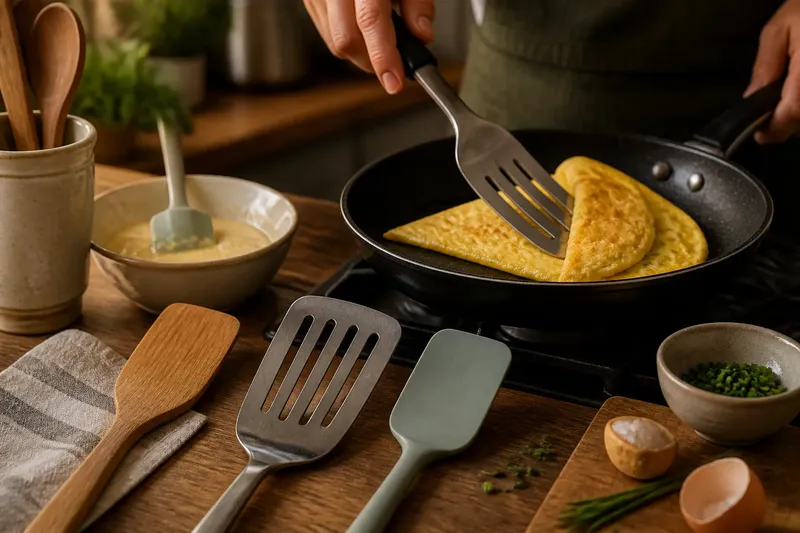
You’re lifting a soft omelette from a coated frying pan, and the blade catches at the edge. Choosing a wood, metal or silicone spatula starts with the pan maker’s utensil guidance, then turns on how you cook and clean.
These materials differ in stiffness, flexibility and care. The right one may be a single everyday tool or a small pair for distinct jobs, rather than a set of near-identical blades.
Choose wood for firm stirring and a simple grip
A wooden spatula feels solid in the hand and works well for stirring thick mixtures, folding vegetables through sauce and moving ingredients around a pan. Its broad blade is useful for pushing and mixing, though a thicker edge may be awkward when you need to get underneath delicate food.
Wood is a natural choice when you want a simple, non-metal tool, but it needs prompt care. Wash it by hand with washing-up liquid, rinse it and dry it rather than leaving it to soak. Follow the maker’s care instructions, and stop using it if the blade becomes splintered, deeply grooved or difficult to clean.
Choose metal for stiffness and precise lifting
A metal turner has a firm blade that can support food as you lift it. The profile and shape matter: a slotted blade lets liquid drain, while a solid blade supports food across a more continuous surface. A narrow turner suits smaller portions; a broad one gives larger pieces more support.
Use metal only on cookware whose maker permits it. A pan designed for gentler utensils may be scratched by a metal edge, even when the tool is used carefully. Metal can also become hot near a hob, so hold the handle and follow the utensil maker’s instructions.
Choose silicone for scraping and flexible contact
A silicone spatula bends around the curve of a mixing bowl, making it useful for gathering batter, sauce or custard from the sides. It can also suit coated cookware when the pan instructions allow silicone utensils.
Blades vary in firmness. A soft one folds and scrapes easily but may flex too much for a heavy portion; a sturdier turner offers more support. Check the label for heat guidance and care instructions. With a joined handle, inspect the connection for food-catching gaps; a one-piece design avoids that particular seam.
Which spatula suits your cooking routine?
Which spatula should I use with a coated pan?
Check the pan maker’s instructions and use a material they permit, commonly wood or silicone. Choose a smooth, undamaged blade and avoid forceful scraping.
What should I use to lift delicate food?
Choose a turner with enough support for the portion and a blade that can approach it without pushing it apart. For coated cookware, the material still needs to meet the pan maker’s guidance.
Is silicone better for mixing bowls?
Its flexible edge can follow a bowl’s curve and gather ingredients from the sides. A firmer blade may be more comfortable for stirring a dense mixture.
Can one spatula cover every task?
A sturdy silicone turner can handle many everyday jobs, but it may not offer the firm support of a metal turner or the feel of a wooden stirring tool. If you buy only one, choose for the task and cookware you use most.
Build a small set around distinct tasks
Start with the job that feels awkward, then add another tool only if it solves a different problem. A flexible spatula for scraping and a firmer turner for lifting can make a useful pair, provided each suits the relevant cookware.
Say you have a coated frying pan, a stainless-steel pan whose maker permits metal tools, and a mixing bowl you use for cake batter. First, read the coated pan’s instructions and choose a silicone turner if approved. Next, choose a metal turner for the stainless-steel pan if its guidance allows it. Keep a flexible silicone spatula for gathering batter from the bowl. The result is a distinct tool for each surface and task; if you want to keep only two, use the silicone spatula for the bowl and coated pan, and reserve the metal turner for the stainless-steel pan.
- Check the pan instructions: if they permit metal, a metal turner is an option; if they call for gentler utensils, choose an approved wood or silicone tool.
- Check the utensil edge: if it is smooth and intact, keep using it; if it is rough, cracked or splintered, replace it.
- Check blade firmness: if it supports the food you lift, keep it for that task; if it bends too much, choose a firmer turner.
- Check blade flexibility: if it follows the curve of your bowl, use it for scraping; if it stays rigid, choose a more flexible spatula for that job.
- Check handle joins: if the connection is easy to clean and remains secure, keep the tool; if food lodges in an inaccessible gap or the handle loosens, choose a different design.
- Check care instructions: if the tool’s washing and heat guidance fits your routine, keep it in consideration; if it requires care you will not follow, choose a tool with more suitable instructions.
When choosing a wood, metal or silicone spatula, begin with the cookware rules, then match the blade’s stiffness and shape to your usual tasks. That order helps you avoid buying a tool that suits the food but not the pan, and leaves you with a set you can actually maintain.