The Handmade Look Is Not the Same as Handmade
The handmade look is not proof of hand production. Learn how to assess a surface, weigh competing explanations and check claims before describing an object.
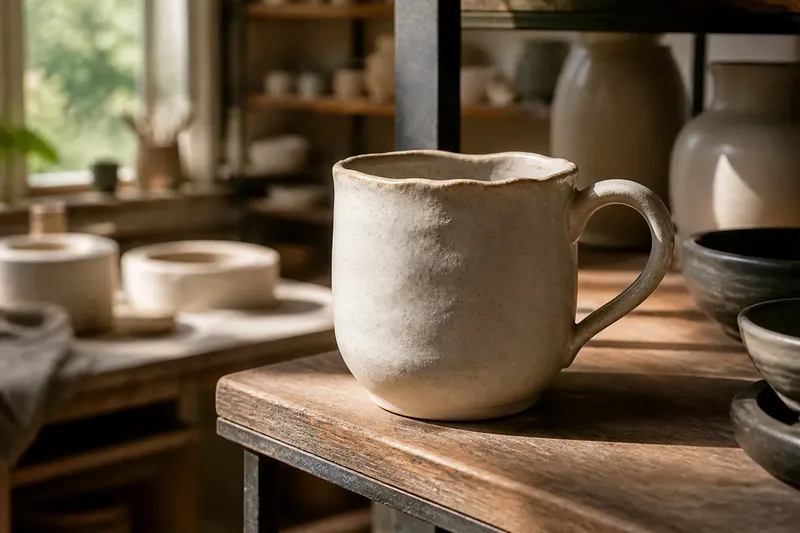
A mug on a shop shelf catches the light along its rippled rim. Its matte glaze and softened handle make it look handmade, but a surface can imitate the character of handwork without revealing how the object was produced. The handmade look is an aesthetic effect; to assess a production claim, look for information about the object’s making beyond that effect.
The handmade look describes a style, not a process
“Handmade” can refer to one stage of production or several. A maker may shape a vessel by hand and use a mould for a repeated component. A factory may form the main shape with machinery, then add decoration or finishing by hand. The words on a label need to make clear which part of the work they describe.
The handmade look is built from visual choices: irregular outlines, tactile surfaces, softened edges, uneven colour or marks associated with tools. These qualities can come from skilled handwork, but they can also be designed into moulds, surface treatments and factory processes. The appearance may be consistent across a whole range of objects, even when it suggests variation.
So begin by asking what the object looks like, then ask what evidence supports a claim about how it was made. Those are related questions, but the answer to one does not settle the other.
Read the surface as a design decision
Instead of treating a quirky detail as a clue to the maker’s hand, consider how it contributes to the object’s visual character. Does a rough patch contrast with a smooth body? Does a wavering outline soften the form? Does a repeated texture create rhythm across the surface? These questions explain what the detail does in the design without assigning it an unsupported production story.
Materials and finishes also affect what you see. Glaze can gather in a recess, brushed metal can carry directional lines, and wood grain can remain visible beneath a clear finish. A textured coating may conceal the surface underneath. The visible character is worth describing in its own right, even if the process that produced it remains unknown.
Look across the whole object rather than letting one dramatic feature dominate. Compare how a finish behaves on broad surfaces, edges and joins. A texture that continues in a regular pattern may be a deliberate design feature; an abrupt change may mark a boundary between materials or treatments. Neither observation, on its own, identifies the tools or people involved.
Use a repeatable method to assess a claim
When a listing calls an object handmade, keep a short record that separates what the seller says from what you can confirm. Use a phone camera in even light, a notes app and the listing text. For each point, record the observation and choose a next action based on what it reveals.
- Check the wording: If the listing says only “artisan style” or “handmade look”, treat it as a description of appearance and ask for a specific production claim; otherwise, note exactly which stage it says is done by hand.
- Check the object’s scope: If “hand-finished” does not say which parts receive that work, ask whether it refers to the body, decoration, assembly or surface; otherwise, keep the claim limited to the named stage.
- Check for supporting detail: If a maker’s account or production description explains a process, record it as supporting context; if there is no such information, leave the method unconfirmed.
- Check whether the account matches the whole object: If the information describes only one component or stage, describe that part rather than calling the whole object handmade; otherwise, use the wording the source supports.
- Check what a photograph can show: If the image hides the underside, joins or finish changes, ask for a clearer view; if those areas are visible, describe them without treating appearance as proof of manufacture.
- Check for conflicting wording: If a label and listing make different claims, ask the seller or maker to clarify before repeating either as fact; if they agree, still state only the specific process they identify.
Say you are considering an invented ceramic cup whose shop listing calls it “hand-finished”, with a rippled rim and a smooth base visible in the photographs. You first record the listing’s exact wording, then note the rim and base as design features rather than evidence. Because the listing does not say which stage is hand-finished, you message the seller to ask whether the phrase refers to the rim, glaze or another part. Imagine the seller replies that workers inspect and smooth the rim after the cup is moulded: your resulting description can say that the cup is moulded and its rim is hand-finished, while leaving other stages unspecified. If no reply arrives, the trade-off is clear: you can describe the appearance confidently, but should leave the production claim unresolved.
What can the handmade look tell you?
Does an irregular edge prove hand shaping?
No. An irregular edge can be a design feature or result from a range of production and finishing processes. Describe its shape, but do not use it alone to identify how the object was made.
Can factory-made objects have a handmade look?
Yes. Moulds and surface treatments can reproduce softened contours, varied textures and other qualities associated with handwork. The appearance does not identify the production setting.
What should I ask a seller about “hand-finished”?
Ask which part of the object is finished by hand and what that work involves. A clear answer distinguishes a specific production stage from a general style claim.
What evidence supports a production claim?
Look for a maker’s account, a reliable label or a production description that identifies a process and says which parts it covers. Treat vague marketing language as a claim to clarify, not as something the surface confirms.
Describe appearance without assigning a maker
For a useful object description, name the visible qualities first and keep production claims separate. You might write, “The cup has a rippled rim, a matte glaze and a smooth base.” If a maker’s account says the rim is finished by hand after moulding, add that specific information as a separate sentence. This keeps the visual description useful even when production details are incomplete.
When comparing two objects, use similar views and lighting. A shadow can make an edge appear uneven, while a close photograph may exaggerate texture. If you are relying on online images, say so and avoid conclusions about details the photographs do not show.
The phrase handmade look is useful when it names an aesthetic rather than standing in for a production history. Describe the design qualities you can see, check what a maker or seller says about the process, and keep any final claim as narrow as the supporting information allows. That gives readers a clearer account of both the object’s character and what remains unknown.