The Long Life of the Button
The long life of the button reveals how ornament became a clothing fastener and how material, placement and construction can help you read a garment.
A loose button rolls beneath a kitchen table, and the shirt it came from suddenly needs a pin or a careful tuck. The history of the button begins with a different role: in many early examples, it was an ornament rather than a familiar clothing fastener.
Early buttons served as ornaments
Some of the earliest known buttons were decorative objects, attached to clothing or worn as jewellery. Makers worked materials such as shell, bone, stone and metal into forms that could display skill or signal access to valued goods. A button could sit on a garment without passing through a buttonhole.
Appearance alone does not tell you what a button does. A disc with a shank, loop or holes can be attached in several ways, and its purpose depends on the garment’s cut and construction. Ties, pins or lacing could hold clothing closed while buttons supplied decoration.
A row of decorative buttons could draw the eye along a sleeve or across a bodice. Their material and finish made clothing a surface for display, even when another device did the practical work of fastening.
Buttonholes made buttons functional fasteners
Buttons became working fasteners when garment-makers paired them with buttonholes. A button could pass through a stitched opening and hold overlapping edges together; the wearer could pull it back through to open them. The change did not happen everywhere at once, and the timing and form of button fastening varied across garments and clothing traditions.
This pairing gave makers another way to construct closures. Lacing uses cords threaded through several points, while a button front can be opened at selected places. Neither method suits every garment: the best choice depends on the cut, fabric and movement the clothing needs to allow.
A button’s function comes from the whole arrangement: button, opening, fabric and the body moving inside the garment. Buttons on a cuff may secure a sleeve opening; a row down a shirt front can let the wearer dress without pulling the garment over the head.
Button placement follows clothing conventions
Button placement reflects traditions of garment-making and dressing, not a mechanical rule. Many garments conventionally associated with women and men have placed closures on opposite sides, but the arrangement varies by garment, maker and market. Contemporary clothing may follow either convention or ignore it.
Explanations often link the difference to past dressing practices, such as assistance from attendants or preferences for using one hand. Such accounts do not explain every garment or period. You can inspect the closure itself: note which edge overlaps, where the buttonholes sit and how the arrangement works for the intended wearer.
On a vintage garment, the side can offer a clue about its design tradition, but it cannot identify a wearer or establish how the garment was made. Read the cut, seams, fabric and fasteners together rather than treating button direction as a label.
Materials connect buttons to craft and use
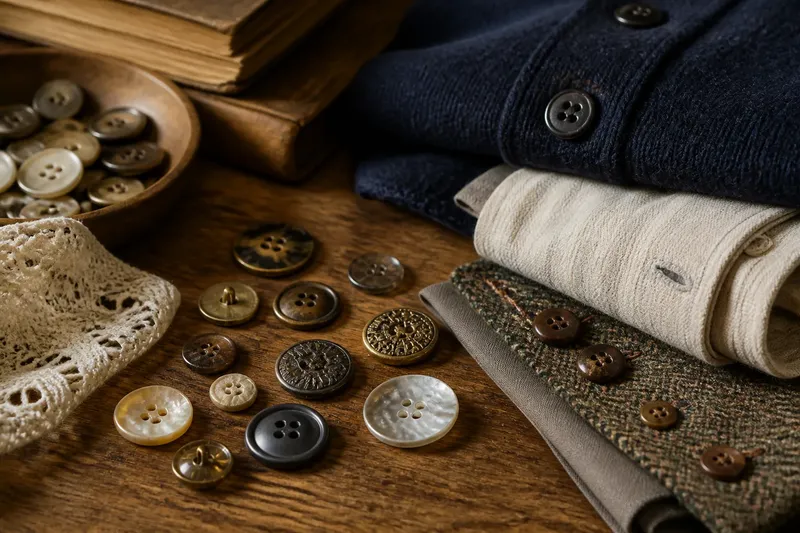
Button materials reflect available craft and manufacturing methods. Shell, horn, bone and wood can be cut or carved; metal buttons can be stamped or cast. Glass and manufactured plastics gave makers other ways to create consistent shapes and colours, including finishes that imitate costlier materials.
Material is not a simple scale from precious to cheap. A plain, sturdy button may suit workwear, while a carefully finished one can make a modest garment look formal. Weight and surface matter too: a heavy button may pull at fine cloth, and a rough edge can catch on a knit. Makers choose buttons in relation to fabric and intended use.
Say you inherit a wool cardigan with one missing button. The remaining buttons are dark, slightly domed and attached with a raised shank. You compare a few replacements against them, checking shade, thickness, edge and attachment, then choose one that sits similarly on the knit. The expected result is a closure that looks consistent and closes without dragging the wool out of shape; if no close match is available, keeping the original buttons and using a discreet substitute may preserve more of the cardigan’s character than replacing the whole set.
Buttons remain repairable, but they have limits
A loose button can often be sewn back on with needle and thread, which makes the closure relatively straightforward to repair. Buttons also let a wearer open only part of a garment, a useful feature on shirts, cardigans, cuffs and many coats.
They can take longer to fasten than a zip, and buttonholes may stretch. Small closures can also be awkward for someone with reduced dexterity. Snaps, hooks, ties, zips and hook-and-loop tape address different needs; garments sometimes combine them, such as a coat with a zip beneath a buttoned storm flap.
Before repairing or replacing a button, check the care label and any maker’s instructions. Thread, attachment and material should suit the fabric and construction. If a repair could damage a delicate or valuable garment, ask a qualified textile conservator or experienced garment repairer.
How can you read a button without overclaiming?
Does a button’s material identify when a garment was made?
No, not by itself. Similar-looking buttons can be made from different materials and in different periods, so treat material as one clue alongside construction, wear and the rest of the garment.
What is the difference between a shank button and a flat button?
A shank button has a loop or raised attachment on its back, leaving space between button and fabric. A flat button is sewn through holes in its face and generally sits closer to the cloth.
Why do some garments have buttons that fasten nothing?
Some buttons are decorative, preserve the look of a traditional design or cover a fastening beneath them. Check for a matching buttonhole or loop before assuming the button is meant to open the garment.
Can a button suggest how a garment was used?
It can suggest a purpose when considered with the garment’s shape and the button’s placement. Sturdy buttons on a thick cuff serve a different likely need from tiny decorative buttons on a formal bodice, but neither detail proves who wore the garment or on what occasion.
Read the button alongside the garment
To read a button, note its material, finish, number of holes, attachment style, spacing and condition, then compare those features with the fabric and cut. The long life of the button rests on its ability to serve as ornament, closure and repairable hardware, while also leaving visible clues about how clothes were designed to be worn.
When a button comes loose, look at its opening and position before replacing it. That small pairing can help you preserve the garment’s construction as well as its appearance.